How Jacket Pockets Changed from Hidden Utility to Visible Design
Jacket pocket history explains how hidden seams, tailored flaps, and visible patches turned practical storage into a deliberate part of a garment’s design.
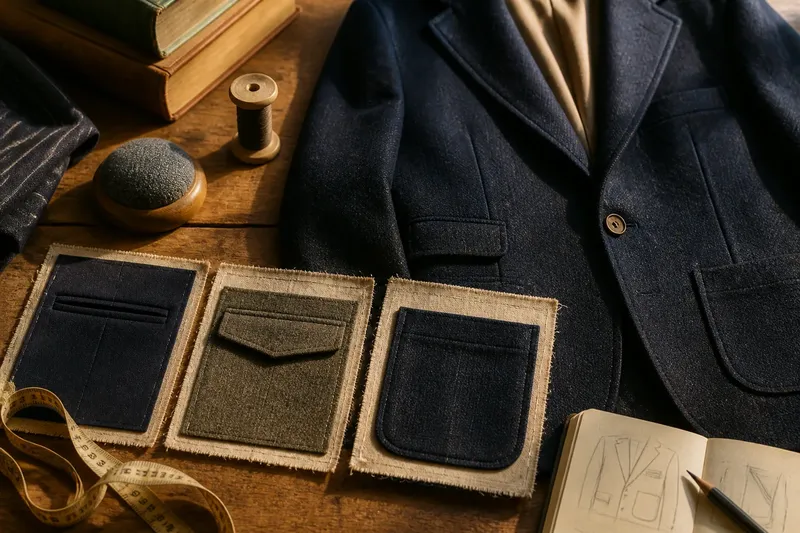
Jacket pocket history is written into the changing front of the garment: a pocket can disappear into a seam, sit beneath a flap, or announce itself as a patch. Those choices reflect more than taste. They show how tailoring balanced storage, formality, and the wish to keep a coat’s surface orderly.
The story is not a straight march from hidden utility to decoration. Different pocket forms have continued to serve different garments and occasions, and a single jacket may combine discreet and visible openings. Looking closely at construction makes those shifts easier to read.
From seams to storage
Early pockets were not always sewn into clothing. Small personal belongings could be carried in separate pouches, often worn beneath or alongside garments. As clothing construction developed, openings and pocket bags were increasingly incorporated into garments, placing storage closer to the body and making it part of the garment’s design.
In tailored clothing, the side-seam pocket offered a way to keep the front relatively uninterrupted. Its opening could follow an existing seam, leaving the pocket bag inside the garment. The result depended on sound construction: a bulky bag or strained opening could still disturb the cloth.
Tailoring and visible forms
As coats and jackets developed distinct roles, tailors used several pocket constructions. A flap pocket places a fabric flap over an opening; a welt finishes an opening with a narrow strip; a patch pocket is sewn onto the garment’s surface. Each construction presents a different relationship between storage and appearance.
In many tailored jackets, flaps and welts became familiar ways to finish pockets without making the whole pocket bag visible. Patch pockets, by contrast, keep their outline on the surface. They have often suited less formal jackets, though fabric, shape, and placement can change that impression.
These forms are not reliable labels for a garment’s date or social meaning on their own. A pocket’s appearance needs to be read alongside the jacket’s cut, fabric, intended use, and other details. Fashion history is more legible when construction is treated as evidence, not as a single clue with a fixed answer.
Three pocket forms?
What is a welt pocket?
A welt pocket has an opening finished with one or more narrow fabric strips. It creates a controlled line in the garment front, with the pocket bag concealed behind the cloth.
How does a flap pocket differ?
A flap pocket has a piece of fabric covering its opening. The flap may be tucked inside for a cleaner look, but the pocket’s construction remains part of the tailored front.
Why are patch pockets visible?
A patch pocket is attached to the outside of the garment, so its perimeter and stitching remain apparent. That visibility can make it feel relaxed or decorative, depending on its proportions and setting.
Does pocket style date a jacket?
A pocket can contribute to a jacket’s period character, but it cannot date a garment by itself. Compare it with the cut, materials, closures, and signs of alteration before drawing a conclusion.
Reading a jacket
Imagine a vintage navy jacket with a notched lapel, horn-style buttons, and two patch pockets. You observe that the pockets are sewn onto the surface and that their stitching differs slightly from the jacket’s other seams. You then compare the pocket shape and construction with the garment’s cut and inspect the seams for signs of later alteration; the result is a more cautious description, such as “a tailored jacket with visible patch pockets,” rather than a firm date based on pocket style alone.
When examining a jacket, use each observation to guide the next decision:
- If the opening follows a side seam, identify it as a seam pocket; if the bag is visible or the edge is strained, describe that construction detail rather than calling the pocket fully concealed.
- If a narrow strip finishes the opening, identify a welt; if a broad piece covers it, look for a flap and describe the two parts separately.
- If the pocket sits on top of the cloth, identify it as a patch pocket; if its edges disappear into the garment, inspect the seam or welt before deciding how it is made.
- If the pocket shape seems inconsistent with the jacket, inspect nearby stitching for alteration; if the stitching appears continuous, record the pocket as part of the garment’s observed construction without claiming a date.
- If several pocket forms appear together, describe each location and type; if one form dominates, note that pattern while leaving period claims open until other details agree.
- If a pocket flap can be tucked inside, record both the visible and tucked appearance; if it cannot, describe the flap as a fixed design feature.
Function and appearance
A pocket’s history is also a history of competing needs. A clean front can make a tailored jacket seem more formal, while a patch pocket makes its construction conspicuous. Yet visibility alone does not determine use: an elegant welt may be difficult to reach, and a roomy-looking patch may pull on soft fabric when loaded.
For a garment’s original purpose, consider the pocket alongside its fabric and cut. Workwear and casual jackets may favor accessible storage, while dressier tailoring often gives greater attention to a smooth front. These are broad design tendencies, not rules that apply to every jacket.
Jacket pocket history rewards close looking, but it also rewards restraint. Name what the construction shows, compare it with the rest of the garment, and treat any claim about date or meaning as provisional until several details point in the same direction.