Woven or Knitted: What Changes in the Cloth?
Woven or knitted fabric behaves differently under tension and light. Learn to read its structure so you can choose cloth that suits a garment.
Woven or knitted fabric can look similar on a store shelf, yet its structure changes how it stretches, drapes, and holds a surface. To tell them apart, start with the cloth itself: look for crossing yarns or linked loops, then consider how that construction suits the garment you have in mind.
Start with the structure
Woven cloth is made from two yarn systems that cross at roughly right angles. The lengthwise yarns are called the warp; the crosswise yarns are the weft. Their intersections form a grid, even when the weave is too fine to see without close attention.
Knitted cloth is made by drawing yarn into connected loops. Those loops link along rows and columns, giving the fabric a structure that can open and flex without requiring the yarn itself to stretch much. A T-shirt jersey and a ribbed sweater are both knits, though their surfaces and behavior differ.
Construction is not the same as fiber content. Cotton, wool, silk, polyester, and other fibers can be used in woven or knitted fabrics. A fabric’s hand and performance come from the combination of its fiber, yarn, construction, and finishing, so a soft feel alone does not identify it.
Read the cloth
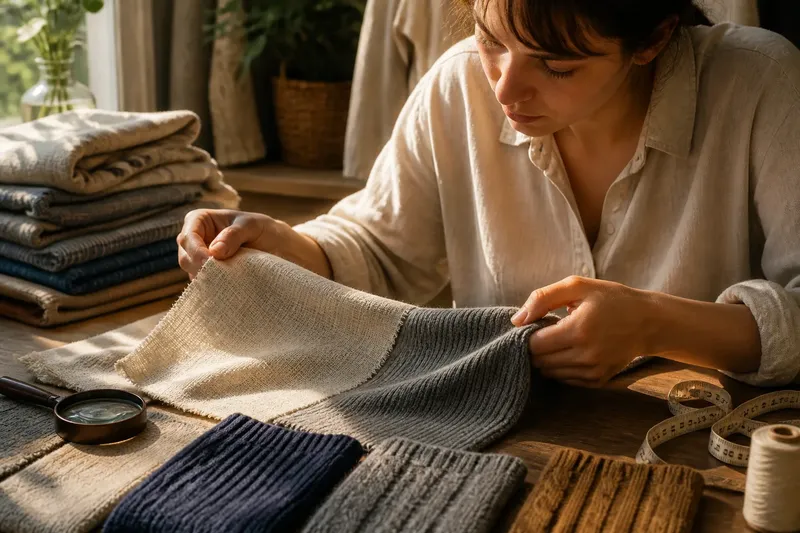
Lay the fabric flat under good light and inspect a cut edge or the inside of a garment. In woven cloth, you may see a tidy crossing pattern; in a knit, look for small loops or columns of stitches. A magnifying glass can help with a fine shirting fabric or a dense sweater knit.
Next, turn the cloth a quarter turn and inspect it again. Woven fabric usually has a visible lengthwise grain and a crosswise direction, while knitted fabric often shows vertical wales or horizontal courses. These lines may be subtle in a smooth jersey, but they become clearer in rib knit or a textured sweater.
Use the selvage if it is available. This is the finished edge running along the length of many woven fabrics, where the crosswise yarns turn back. Knits may have a finished edge too, but the presence of a selvage is a useful clue rather than a complete verdict; some fabrics are finished or cut in ways that obscure their original edge.
Check stretch and recovery
Gently pull a small area across the width, then along the length, and release it. Woven cloth often gives more across the width than along its length, while a knit commonly stretches in both directions because its loops can widen and narrow. The amount varies: a crisp cotton poplin barely yields, while a rib knit can expand noticeably.
Watch what happens after release. A knit may spring back, remain slightly relaxed, or grow with wear, depending on its yarn and construction. Woven fabric may return to its original shape more readily in one direction than the other, but bias-cut cloth can stretch diagonally even when the straight grain feels firm.
For a fair comparison, avoid pulling hard. Strong tension can distort delicate cloth and makes it harder to judge ordinary wear behavior. If you are comparing garments rather than fabric swatches, check a seam or hem too: stitching and elastic can limit or add stretch beyond what the base fabric would suggest.
Notice the surface
Woven surfaces range from smooth and regular to visibly textured. Plain weave has a simple over-and-under appearance; twill creates diagonal lines, as on many denim fabrics; satin weave places longer yarn floats on the surface, producing a smoother sheen. These patterns affect how light moves across the cloth, but they do not by themselves tell you whether a fabric is stiff or fluid.
Knits show their loop structure in different ways. Jersey has a relatively smooth face and a more textured reverse; rib knit has raised columns that can expand; sweater knits may use cables, purl stitches, or open spaces for a pronounced relief. Fleece and brushed knits add a soft surface through finishing, so their nap is not the same thing as the underlying loop pattern.
Run your fingers lightly over both sides, then tilt the fabric toward a window or lamp. Look for sheen, fuzz, raised lines, and differences between the front and back. A surface that looks smooth at a distance may reveal tiny loops or yarn crossings up close.
Match construction to use
Wovens often suit garments that benefit from a stable outline, such as a crisp shirt, tailored trousers, or a structured skirt. The fabric can support clean edges and pleats, though a lightweight woven may still drape softly. Knits often suit clothing that needs movement against the body, such as a tee, leggings, or a soft cardigan.
These are tendencies, not rules. A stretch woven can move comfortably, while a dense, low-stretch knit can hold a firm shape. The garment’s cut, lining, seams, and closures also matter: a woven shirt with a loose cut may feel easier to move in than a close-fitting knit with limited recovery.
Say you are choosing cloth for a loose summer top and have a crisp cotton poplin and a light cotton jersey in front of you. The poplin’s crossing yarns and modest give may create a clean, airy outline; the jersey’s linked loops may follow the body more closely and feel more flexible. If you want the top to skim rather than cling, the cut and fabric weight matter alongside that difference in construction.
Woven or knitted questions?
Can woven fabric stretch?
Yes. Some woven fabrics include elastic yarns, and many give across the width or on the bias. Check the cloth in both directions rather than treating “woven” as another word for rigid.
Can a knit have a smooth surface?
Yes. Fine jersey can look smooth from a distance, although close inspection usually reveals loops on the reverse or along the fabric’s rows. Finishing can also flatten or brush a knit and change its visible texture.
Does a fabric label identify its construction?
Fiber-content labels usually name the fibers, not whether the cloth is woven or knitted. Examine the structure directly, or look for a construction description from the maker when the fabric is too fine to read easily.
Which construction is easier to sew?
Neither is automatically easier; the choice depends on the pattern, equipment, and fabric behavior. A stable woven can be simpler to handle at a seam, while a knit may call for a stretch stitch and a suitable needle so the seam can move with the cloth.
Choose by behavior
Before buying fabric or judging a garment, connect what you see to what you need: a stable outline, flexible movement, a smooth face, or a textured one. Read the loops or crossings, test gentle stretch, and notice how the surface catches light. For a particular garment, follow its care label and the fabric maker’s instructions, since fiber blends and finishes can alter how the cloth should be handled.
When you search for woven or knitted fabric, keep the distinction practical rather than absolute. Construction gives you a useful first prediction; the actual cloth tells you whether that prediction fits the way you want to wear it.