Why a Dart Gives a Flat Piece of Cloth Its Shape
Learn how a dart shapes flat fabric, how to spot its purpose in a garment, and how to tell a fit detail from a purely decorative line.
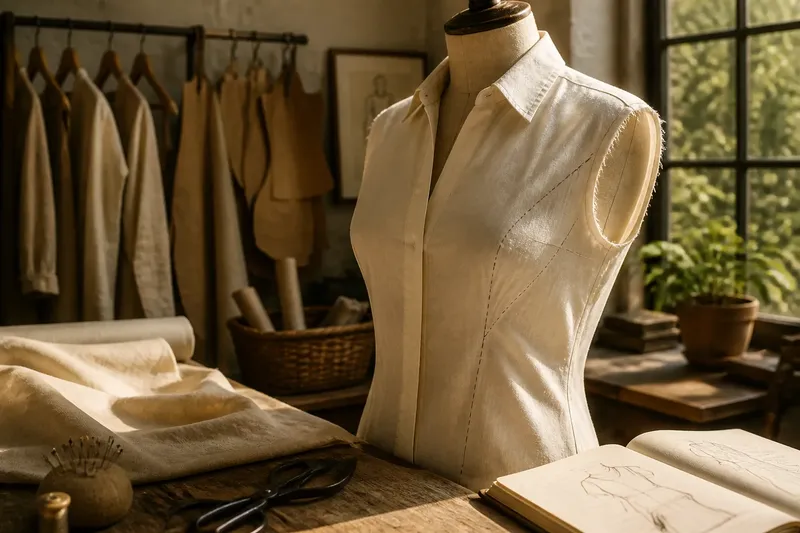
A dart turns flat cloth into a shaped garment by taking in a wedge of fabric, and its position reveals where that shaping is meant to happen. On a fitted shirt, the small tapered seam near the bust is not simply a line on the surface: it changes the cloth’s volume so it can follow the body.
How fabric gains contour
A piece of woven fabric lies flat because its threads cross at right angles. A body does not. To bring a garment closer to a curved area, a maker can join two edges, add shaped panels, gather excess cloth, or fold a wedge and stitch it closed. A dart uses that last approach.
The dart’s wider end takes in more cloth; its narrow point tapers to little or no intake. Once sewn, the surplus is held inside the garment, creating a subtle raised or curved form on the outside. The fabric itself has not been stretched into a new shape. The seam has controlled how much of it remains available to cover the body.
Darts are often found at the bust, waist, shoulder, or back of a garment, but their location depends on the pattern and intended fit. A long, shallow dart can distribute shaping gently, while a shorter, deeper one removes more cloth within a smaller area. The visible seam is only part of the story: its direction and endpoint help explain the contour it creates.
Three shaping choices
Designers can create shape in several ways. Comparing a dart with a seam or a gathered area helps clarify when a dart is doing useful construction work and when a similar line is merely decorative.
Darts for focused shaping
A dart concentrates fabric intake in one place, making it useful when a garment needs to contour around a particular curve without adding a separate piece of fabric. Bust darts commonly begin near a side seam or waist area and point toward the bust, stopping short of the fullest point so the tip does not create a sharp peak.
This approach suits tailored shirts, skirts, dresses, and fitted jackets where a relatively smooth surface matters. It also makes the shaping easier to recognize: look for a tapered seam whose direction appears to aim toward a body curve, and check whether the cloth around it lies more closely to the body than the surrounding area.
Seams for broader shaping
A shaped seam joins two or more fabric pieces whose edges have been cut to create a curve. Princess seams, for example, can run over the bust and continue toward the hem, carrying shaping through a longer section of a garment. Unlike a dart, the seam does not close a wedge within one continuous piece; it joins separate panels.
This option suits designs that need contour over a larger area or that use the seam as a visible design line. Panel seams can also make fitting adjustments more distributed, though what can be changed depends on the garment’s construction and available fabric. If a line runs continuously from the garment’s upper section toward its lower edge, it may be a panel seam rather than a dart.
Gathers for softer fullness
Gathers draw a longer piece of fabric into a shorter space, producing small folds and visible fullness instead of a smooth, controlled contour. They are common at waistbands, cuffs, and yokes, where softness or volume is part of the design.
Gathers suit relaxed shapes and garments that benefit from movement or a fuller silhouette. They are less suited to a surface intended to lie smoothly over a defined curve. If the fabric forms repeated folds rather than a single tapered seam, the shaping likely comes from gathering, not a dart.
Reading a dart’s purpose
Start with the seam’s construction. A conventional dart usually has two stitched lines that converge at a point, with the fabric folded between them. The stitching may be hard to see on the outside, so inspect the inside as well: the folded allowance often shows the wedge that was taken in.
Then consider placement. A dart near the bust usually helps accommodate that curve; a waist dart can remove fullness between the waist and hip or chest; shoulder and back darts can refine how a garment sits across those areas. These are common functions, not fixed rules. A dart’s angle, length, and relation to nearby seams matter too.
Imagine a plain woven shirt that pulls across the chest when its side seams sit comfortably. A maker could add a bust dart aimed toward, but not ending at, the fullest point; the expected visible change is more room and a smoother fall across the chest without simply widening the whole shirt. The example shows why a dart can be functional even when it is barely noticeable.
A dart can also be pressed toward one side, left as a fold, or incorporated into another seam. In a garment with a lining, the shaping may be easier to see on the outer shell before the layers are joined. A decorative stitched line, by contrast, may have no folded wedge or intake behind it.
Questions about darts?
How can I tell a dart from a seam?
A dart typically narrows to a point and closes a wedge in one fabric piece. A seam joins separate pieces, and its stitching may continue along a panel edge rather than tapering to an endpoint.
Why does a dart stop short of the curve?
Ending the stitching at the fullest point can leave a visible bump or point on the garment. A carefully tapered dart stops short so the fabric can settle into a smoother contour.
Are all visible darts functional?
No. A line may be decorative, or it may imitate a dart while taking in little or no fabric. Check the inside for a folded wedge and observe whether the cloth’s shape changes around the seam.
Choosing the right clue
When examining a garment, begin with what the fabric does rather than assuming every stitched line has the same job. A tapered intake suggests localized contour; a long joining seam suggests shaping across panels; repeated folds point to gathers and added softness.
These clues make a useful distinction, but construction can combine methods or conceal them under a lining. For garment changes, the care label, maker’s instructions, and fabric behavior should guide decisions; a qualified alterations professional can advise when the construction is unclear. The most reliable reading of a dart comes from its shape, its placement, and the contour it leaves behind.